Introducing Curve Forms: HIPAA-Aware Intake With Real Attribution
The most important moment in your patient acquisition funnel rarely happens on the ad. It happens at the form.
The most important moment in your patient acquisition funnel rarely happens on the ad. It happens at the form.
A prospective patient sees a Google Ad for your clinic. They click. They land on a page about your weight loss program. They scan a testimonial. They check pricing. They open the booking form. They fill out three fields. They submit.
In most healthcare marketing setups, the only thing that lands in your inbox is the submission. Every signal that explained who that person is and where they came from gets stripped on the way through. You see "Sarah, 31, asthma medication question." You do not see "came from your $40 CPC Google Ads campaign, read two articles, watched the embedded testimonial, hesitated on the pricing page for 90 seconds, then submitted." That context is exactly what would tell you which campaigns deserve more budget and which steps are quietly losing you patients.
That gap is what Curve Forms closes.
What Curve Forms is
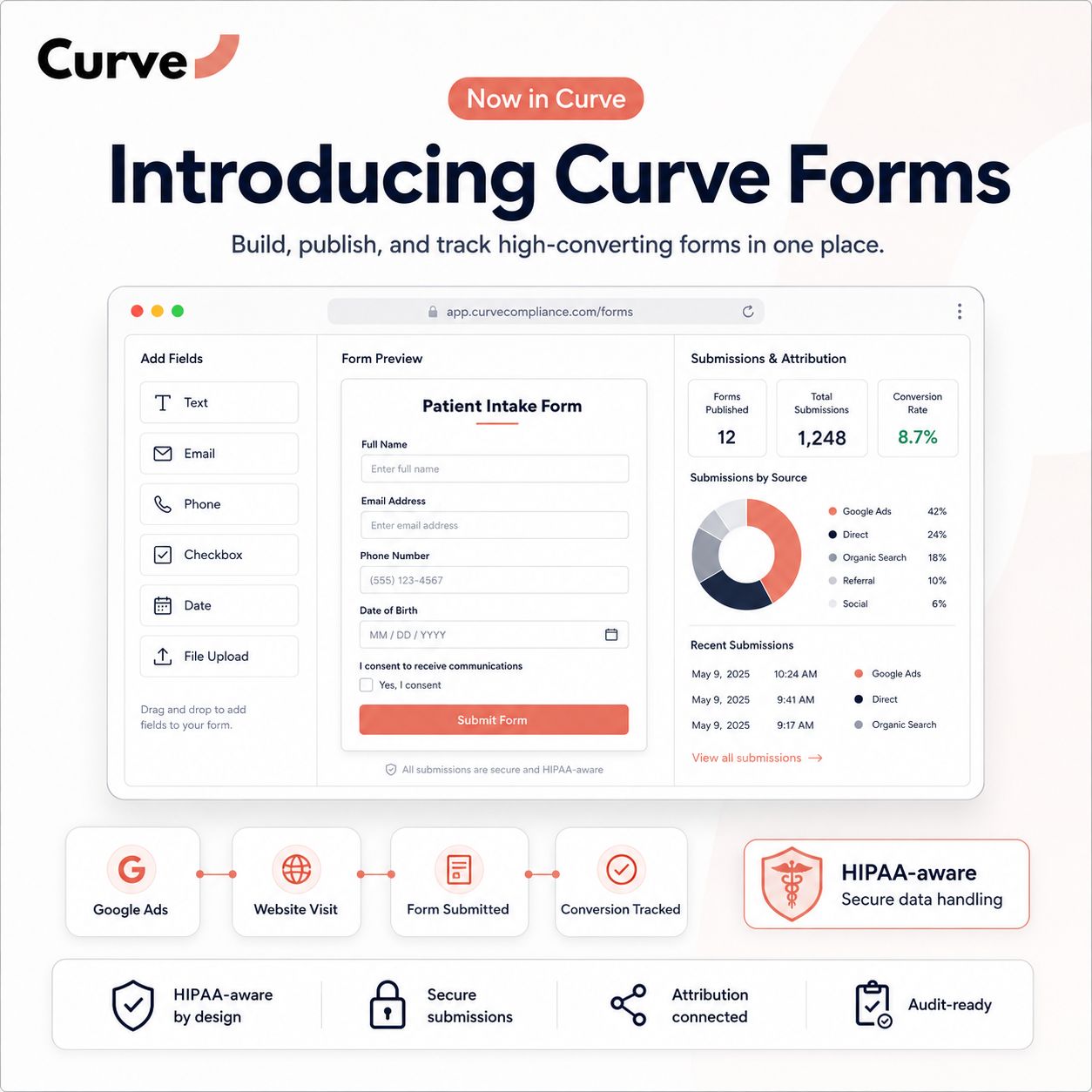
Curve Forms is a HIPAA-aware form builder built directly inside Curve Compliance. It lets healthcare, wellness, and compliance-focused teams design, embed, host, and measure intake forms without leaving the Curve platform.
It is built around a single idea: form submissions should be measurable conversion moments, not isolated inbox entries. Every form a team builds inside Curve is wired into Curve's attribution and analytics infrastructure from the moment it goes live. When someone submits a form, you do not just get the form data, you get the campaign source, landing page, prior page views, and journey context tied to that submission whenever attribution data is available.
The forms healthcare teams actually need
Most general-purpose form builders were designed for generic SaaS lead capture or scheduling. Healthcare workflows are different. Patient intake asks for sensitive information. Referral forms route to multiple practitioners. Consultation requests need consent language. Campaign landing pages need polished branding. Multi-step intake needs to feel light, not bureaucratic.
Curve Forms supports the field types and structures healthcare teams actually use:
- Single-line text, long text, email, phone, date, and file uploads
- Dropdowns, checkboxes, radio selectors, and toggles
- Multi-step flows with progress indicators and conditional logic
- Required fields, custom validation, and consent-aware messaging
- Custom colors, typography, logo placement, and layout settings
- Branded confirmation messages and post-submit redirect behavior
- Embedded on your website or published as standalone hosted links
A team can launch a clean, branded campaign landing form in minutes. Or they can build a detailed multi-step intake flow that gathers everything a new-patient coordinator needs before the first call.
The attribution layer
This is what makes Curve Forms different from a generic form builder.
Every form is wired into Curve's analytics from the moment you embed it. When a visitor lands on your page, Curve already has context about how they got there: which campaign, which landing page, which prior pages they viewed. When they start filling out a form, that becomes a tracked event. When they move from step one to step two of a multi-step flow, that is a tracked event too. When they submit, that submission ties back to the full upstream journey when attribution data is available.
The practical result is that healthcare marketers stop guessing.
Instead of "we got 12 leads this month," a team can see "we got 12 leads this month, seven from our GLP-1 weight loss campaign at a $43 cost-per-lead, three from our referral landing page, and two from organic." Instead of "this form converts at 8%," they can see "step one to step two drops 12% of visitors, step three is the real bottleneck at 31% drop-off." For multi-step forms, step-level tracking is the difference between guessing where people abandon and knowing.
What different teams get out of it
Marketing teams finally get conversion data that ties back to the campaigns paying for traffic. Form submissions become measurable conversions inside Curve's attribution layer, not isolated entries in someone's inbox. Budget decisions become evidence-driven.
Operations and intake teams get a dedicated lead inbox inside Curve. Every submission is reviewable with full context: the form, the answers, the source attribution, the visitor journey, and the current follow-up status. Coordinators see the same record marketers see.
Healthcare leadership and compliance get a form experience designed with privacy-aware messaging, consent language, and a more secure operational workflow than a typical SaaS form tool routing patient data through a generic third-party pipeline.
Privacy-aware by design
Curve Forms inherits Curve Compliance's approach to handling patient data. Sensitive fields are treated with the same controls as the rest of the platform, consent-aware language is available in form copy and confirmation flows, and forms can be configured for the privacy-conscious workflows healthcare teams actually need: limited field visibility, role-based access to submissions, and integration patterns that keep sensitive data inside trusted boundaries.
This is consistent with how the Office for Civil Rights has been framing healthcare data handling and with how recent court rulings on tracking pixels have raised the bar on what generic form tools can safely do inside healthcare workflows. For background on the broader privacy landscape Forms operates inside, see our recent pieces on the FTC Health Breach Notification Rule 2026 expansion and PHI-safe Facebook Lead Ads configuration.
What Curve Forms is not
Curve Forms is not a replacement for your full marketing stack. It does not try to be your CRM, your EHR, your appointment scheduler, or your patient portal. The vision is narrower and more specific: close the gap between form submission and trustworthy attribution that most healthcare teams currently work around with spreadsheets, manual UTM tagging, and best-effort guessing.
For teams that need a form to feel like part of a measurable growth system rather than an isolated tool, Forms is built for exactly that.
Getting started
Curve Forms is available now inside Curve Compliance. Existing customers can start building forms in the new Forms section of the platform. Teams not yet on Curve can book a demo to see how Forms fits into a broader privacy-first marketing infrastructure.
The bigger picture is straightforward. Every form submission represents a person who raised their hand. Those moments deserve to be captured cleanly, understood in context, and acted on quickly. Curve Forms makes each of those steps easier.
Related articles
Want to stay up to date on the latest in healthcare marketing?
Sign up for our newsletter to receive our articles directly in your inbox—covering compliance updates, platform changes, and industry insights.
We respect your privacy. Unsubscribe at any time.