This Week in Healthcare Marketing: LinkedIn Tightened Health Ads, HIPAA Fines Jumped, and the FTC Got Permanent
This week healthcare marketing LinkedIn tightened health ads, HIPAA fines jumped, and the FTC went permanent. Here's what each move means for your campaigns.
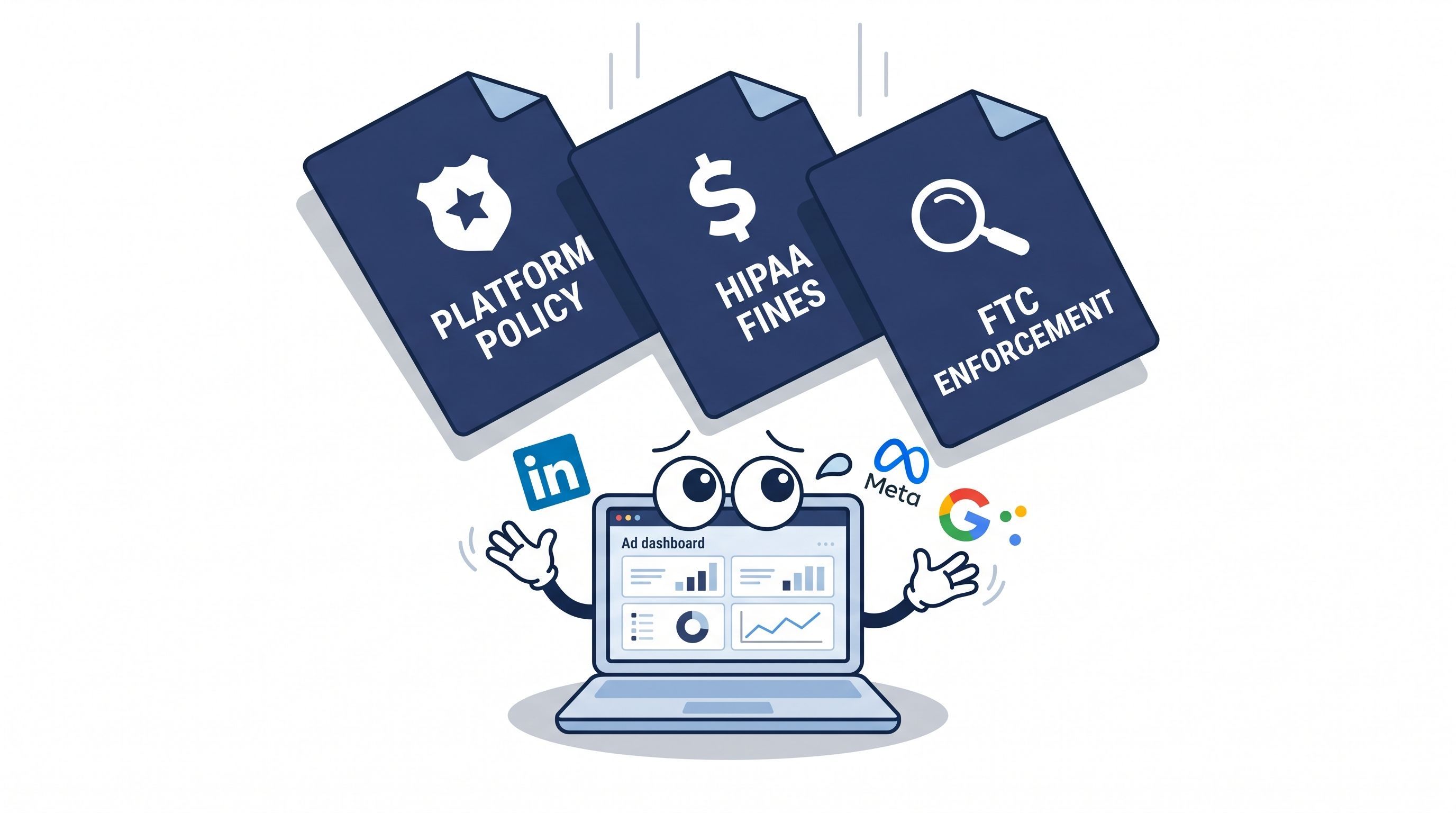
Three Enforcement Moves That Changed the Week
This week in healthcare marketing, LinkedIn tightened its health ad policies, HIPAA fines jumped to inflation-adjusted highs, and the FTC made its healthcare compliance unit permanent. Any one of these would be worth paying attention to. All three landing in the same window is a signal.
The enforcement pressure on healthcare advertising is no longer coming from a single direction. Platform policy teams, federal regulators, and dedicated task forces are all moving at once, and they're moving toward the same conclusion: healthcare organizations that share patient data with ad platforms are going to get caught.
For marketing teams running paid campaigns on Meta, Google, LinkedIn, or TikTok, the calculus changed this week. The platforms are restricting what you can target. The fines for mishandling Protected Health Information are higher than they were last year. And the FTC now has a permanent team whose entire job is finding healthcare companies that play loose with patient data.
Each of these developments deserves a closer look, because the practical implications for campaign structure, tracking infrastructure, and legal exposure are different depending on which one you're dealing with. Most healthcare marketers will be dealing with all three.
LinkedIn's New Health Ad Restrictions, Explained
LinkedIn's 2026 health advertising policy update restricts ads that imply, reference, or rely on sensitive health information. The platform also limits audience targeting options that could allow advertisers to infer a user's health status, treatment history, or medical conditions.
For B2B healthcare advertisers, this is a bigger deal than it sounds.
LinkedIn has always been the "professional" platform, and that framing gave healthcare SaaS companies, medical device manufacturers, and telemedicine platforms a false sense of security. The logic went something like: we're targeting by job title and company size, not by health condition, so health ad restrictions don't apply to us.
That logic no longer holds. LinkedIn's updated policy, as detailed by Accelerated Digital Media's platform policy analysis, applies to the ad content and the targeting methodology. If your ad copy references specific conditions, treatment outcomes, or patient populations in ways that could identify health status, it falls under the new restrictions. If your targeting combines industry filters with engagement signals that could infer health-seeking behavior, LinkedIn can flag or reject the campaign.
This mirrors what Meta did in 2022 when it removed detailed targeting options related to health topics, and what Google has been tightening incrementally through its healthcare and medicines advertising policies. The difference is timing. Most B2B healthcare marketers already adapted their Meta and Google campaigns years ago. LinkedIn restrictions are catching teams mid-campaign with targeting structures they assumed were compliant.
Telemedicine platforms and digital health SaaS companies that rely on LinkedIn for demand generation need to review active campaigns now. The targeting options that worked last quarter may not survive this quarter's policy review.
What LinkedIn Actually Changed in Targeting
Before the 2026 update, LinkedIn gave health advertisers wide latitude in audience building. You could target by job title, industry, skills, group memberships, and interest categories without restriction. For B2B healthcare companies, this was the entire playbook.
The new policy draws a line between professional attributes and behavioral signals that could infer health status. Job titles and industry filters remain largely intact. What changed is how LinkedIn treats engagement-based and interest-based audience segments tied to health topics.
A concrete example makes this clearer. A telemedicine company targeting users with the job title "Mental Health Counselor" is still permissible. That's a professional attribute. But targeting users who recently engaged with mental health content on LinkedIn, joined mental health support groups, or followed pages related to specific conditions now falls under the restricted category. LinkedIn's position is that engagement with health content can function as a proxy for personal health status, even on a professional platform.
This distinction breaks a common B2B targeting pattern. Many healthcare SaaS companies built lookalike and retargeting audiences from users who interacted with health-related posts or articles. Those audience segments now need to be rebuilt around professional criteria only.
The practical impact hits campaign structure directly. Custom audiences built from content engagement need to be audited. Retargeting pools that mixed professional intent with health-topic interaction need to be segmented and cleaned. Campaigns that ran fine last quarter may now violate the updated policy, and LinkedIn has indicated it will enforce through ad disapprovals and account-level restrictions.
HIPAA Penalties Hit $2.13 Million Per Category in 2026
While LinkedIn was rewriting its ad policies, OCR quietly updated its HIPAA penalty tiers for 2026. The numbers are inflation-adjusted, and they hit harder than most marketing teams realize.
The four-tier structure still applies, but every dollar amount went up. Tier 1 (the organization didn't know and reasonably couldn't have known) starts at $141 per violation and caps at $36,500. Tier 2 (reasonable cause, not willful neglect) ranges from $1,424 to $71,162. Tier 3 (willful neglect, corrected within 30 days) runs from $14,232 to $71,162. Tier 4 (willful neglect, not corrected) maxes out at $2.13 million per violation category.
Those are per-category caps, not per-incident. A single tracking misconfiguration affecting thousands of patients can generate penalties across multiple violation categories simultaneously. OCR enforced over $4.2 million in penalties in 2024 alone, and the 2026 adjustments push the theoretical ceiling even higher.
The critical detail for healthcare marketers: tracking pixel violations are not landing in Tier 1. Regulators have consistently argued that organizations should have known their client-side pixels were transmitting PHI to third parties. The Meta Pixel's data collection behavior has been publicly documented since at least 2022. Google Analytics PHI risks have been covered in OCR guidance repeatedly. Claiming ignorance in 2026 is a tough sell when the entire industry has been on notice for years.
That shifts most pixel-related enforcement into Tier 3 or Tier 4 territory, where fines start at $14,232 per violation and the ceiling is measured in millions. And federal fines are only one layer of exposure.
State Attorneys General Are Stacking Penalties on Top
Federal HIPAA fines are only one layer of exposure. State attorneys general are filing their own actions under independent health privacy statutes, and they are not waiting for OCR to go first.
California, New York, Massachusetts, and Washington all maintain state-level health data privacy laws that operate separately from HIPAA. When a tracking pixel violation occurs, it can trigger enforcement from OCR and a parallel investigation from the state AG's office. These are not theoretical scenarios. They are happening right now, repeatedly, across multiple states at once.
The numbers reflect this. Over 200 class-action lawsuits have been filed against healthcare organizations specifically for tracking pixel violations. Kaiser Permanente settled for $47.5 million after its tracking pixels exposed data on 13.4 million patients. BetterHelp paid $7.8 million to the FTC for sharing health data with advertisers. Neither case stopped at a single jurisdiction or a single enforcement body.
This is the compounding problem healthcare marketers need to internalize. A single misconfigured pixel on a patient-facing page can generate an OCR penalty under HIPAA, a state AG enforcement action under local privacy law, and a private class-action lawsuit filed by affected patients. All three can proceed simultaneously. The fines stack. The legal costs stack. The settlements stack.
The previous section covered what one federal penalty tier looks like in isolation. In practice, no penalty arrives in isolation anymore.
The FTC's Permanent Healthcare Task Force
On March 20, 2026, the FTC announced a dedicated Healthcare Compliance Task Force. This is not a temporary initiative or a working group with a sunset date. It is a permanent unit with its own staff, budget, and investigative pipeline.
The structure matters. The task force combines competition enforcement, consumer protection, and technology enforcement into a single team focused exclusively on healthcare. Previously, FTC actions against healthcare companies were handled by whichever division picked up the case. The BetterHelp investigation lived in one group. The GoodRx case lived in another. Institutional knowledge scattered across divisions, and enforcement depended partly on which staff happened to be available.
A permanent task force changes that math. Dedicated investigators build pattern recognition. They see the same tracking vendors, the same pixel configurations, and the same data flows showing up across multiple targets. Each investigation feeds the next one.
The FTC had already been signaling this direction. Thirty telehealth companies received joint FTC/HHS enforcement letters specifically about ad-tracking practices before the task force was even announced. Those letters were not friendly reminders. They were evidence preservation notices, the kind regulators send when they are building cases and want to make sure records do not disappear.
The Mintz analysis of the announcement flagged something worth noting: the task force's mandate explicitly covers data-sharing between healthcare organizations and technology platforms. That language is broad enough to cover nearly every ad tracking integration running on a healthcare website today.
Combined with the state AG actions piling up and OCR's inflation-adjusted penalty increases, the FTC's move adds a third federal enforcement vector. Healthcare marketers now face scrutiny from regulators who are comparing notes.
What the Task Force Means for Ad Tracking Specifically
The Mintz and Consumer Financial Services Law Monitor analyses both zero in on the same point: this task force will focus heavily on data-sharing between healthcare organizations and advertising platforms. Meta Pixel, Google Analytics, TikTok Pixel, and every other client-side tag that sends identifiable data to third-party servers are directly in scope.
The critical distinction most marketing teams miss is jurisdictional. The FTC does not need a HIPAA violation to come after you. It enforces under Section 5 of the FTC Act, which covers unfair or deceptive practices, and under the Health Breach Notification Rule, which applies to entities that handle health data but fall outside HIPAA's covered entity definition.
GoodRx is the clearest example. That $25M settlement was an FTC action, not an OCR action. GoodRx shared user health data with Meta and Google through tracking pixels. The FTC argued this was deceptive because users were told their data was private. No HIPAA violation was required to trigger a federal enforcement action and a eight-figure penalty.
A permanent task force with dedicated staff means this kind of investigation becomes routine, not exceptional. The 30 telehealth companies that already received joint FTC/HHS enforcement letters about ad-tracking practices were early signals. With institutional knowledge now accumulating inside one unit, expect the pace of investigations to increase and the time between complaint and action to shrink.
If your tracking pixels touch health-related user data in any form, the FTC now has a standing team whose job is to find you.
The Compliance Gap Most Healthcare Marketers Miss
With enforcement converging from three directions, the technical reality inside most healthcare organizations hasn't caught up.
The core problem is architectural. Standard tracking pixels from Meta, Google, and TikTok fire inside the user's browser. They collect page URLs, form field data, query parameters, and IP addresses, then send everything directly to third-party ad platform servers. No one on your team inspects that data before it leaves. If a URL contains /appointments/depression-treatment or a form field captures a patient name, that information is already gone.
Most marketing teams assume this was handled. Someone on the dev team installed the pixels. Legal approved a cookie consent banner. The box feels checked.
It isn't.
OCR, the FTC, and state attorneys general have all made the same point in enforcement actions: consent banners do not authorize PHI disclosure to advertising platforms. A patient clicking "Accept Cookies" does not constitute a valid HIPAA authorization. The BetterHelp and GoodRx settlements both involved organizations that had consent mechanisms in place. Regulators didn't care.
The architecture regulators expect is server-side tracking. Data gets intercepted before it leaves your infrastructure, PHI gets identified and stripped, and only clean conversion data reaches the ad platform. The pixel never talks to Meta or Google directly. Your server does, after filtering.
That's the gap. And it's where most organizations are still exposed.
How Curve Handles This at the Infrastructure Level
The architecture regulators expect is server-side tracking that intercepts data before it leaves your infrastructure. That's what Curve does.
Curve replaces client-side pixels with a server-side layer that sits between your site and the ad platforms. When a conversion fires, the data routes through Curve's US-hosted servers first. PHI gets automatically detected and stripped before anything reaches Meta, Google, or TikTok. The ad platforms still receive the conversion signal they need for attribution and optimization. Your marketing team keeps full campaign performance data. The difference is that no identifiable patient information ever touches a third-party server.
Every Curve account includes a signed BAA. That alone puts it ahead of most tracking setups, where the vendor either refuses to sign one or doesn't think they need to.
Implementation takes about a week. Traditional compliance solutions in this space typically require 6+ months of engineering work and custom integration. Curve doesn't require your engineering team on the client side.
On cost: Curve starts at $899/month. The major alternatives in HIPAA-compliant tracking charge $30,000 to $50,000+ per year. Given the penalty tiers and settlement amounts covered above, the math on compliance infrastructure isn't complicated.
What Healthcare Marketing Teams Should Do This Week
Start with your tag audit. Open your site in Chrome DevTools, click the Network tab, and watch what fires on page load. Every request going to facebook.com, google-analytics.com, analytics.tiktok.com, or similar domains is a client-side tag transmitting data before you can inspect it.
Check what those tags are sending. URL paths that contain /conditions/, /appointments/, or /patient-portal/ are PHI vectors. So are form field values, query parameters like ?diagnosis= or ?provider=, and referrer headers from logged-in patient pages.
Pull up your LinkedIn campaigns and review targeting criteria against the 2026 restrictions. If you are building audiences around health content engagement rather than professional job titles, those campaigns likely need restructuring before LinkedIn flags or pauses them.
Confirm you have a signed BAA with every vendor that touches patient data in your tracking stack. Cookie consent platforms, analytics tools, conversion APIs, all of them. If a vendor won't sign a BAA, that tells you everything you need to know about their compliance posture.
If you want a fast read on where your current setup stands, Curve's free HIPAA compliance checker runs through the major exposure points in a few minutes.
Three separate enforcement bodies are now actively investigating healthcare ad tracking. OCR, the FTC, and state attorneys general are not coordinating with each other, but they are all looking at the same data flows. The organizations that audit now choose their remediation timeline. The ones that wait will have it chosen for them.
Related articles
- GuideGoogle Ads Pixel and Google Ads S2S Pixel in the FTC's Hims and Hers Complaint
- GuideThe Meta Pixel and Conversions API in the FTC's Hims and Hers Case: What Healthcare Advertisers Should Learn
- GuideGLP-1 Side Effect Disclosure in Healthcare Ads: FTC and FDA Requirements
- GuideLinkedIn Ads for Health Systems: B2B Without PHI
Want to stay up to date on the latest in healthcare marketing?
Sign up for our newsletter to receive our articles directly in your inbox—covering compliance updates, platform changes, and industry insights.
We respect your privacy. Unsubscribe at any time.